+86 18366183241


In today’s super competitive market, picking the right wholesale custom electrical compressor isn’t just a minor detail—it's actually pretty key to your business’s success. James Anderson, who’s an industry pro at Compressor Solutions, puts it nicely: "Choosing the right compressor can really make or break your efficiency." That just goes to show how important it is to weigh your options carefully before making a pick.
Knowing exactly what you need is super important. Every electrical compressor comes with its own set of features, designed for different jobs. Things like how much power it needs, its size, and whether it plays well with your existing setup—these are all stuff you can’t ignore. For example, if space is tight but you still need something powerful, a small but hefty model might be just what you’re after.
And hey, looking back at past choices can actually be pretty helpful. What worked well before? What didn’t? Taking time to think over past experiences can definitely help you make smarter decisions this time around. Don’t be shy about chatting with reputable suppliers and throwing questions their way. Building a good relationship with experts can give you some solid guidance. Remember, choosing a quality electrical compressor isn’t just about the price—it’s a decision that can impact your business for years down the road.
Custom electrical compressors are essential in various industries. They provide efficient compression solutions for different applications. According to a market analysis by Mordor Intelligence, the global compressor market is expected to grow significantly, with a compound annual growth rate (CAGR) of 4.2% from 2021 to 2026. This highlights the increasing demand for tailored solutions, including the 10hp Compressor.
The significance of custom electrical compressors cannot be overstated. They enhance productivity and reduce operational costs. Custom units can fit specific needs, optimizing energy consumption. Research by the U.S. Department of Energy indicates that efficient compressors can save businesses up to 30% on energy costs. Such savings can make a substantial difference in overall expenses.
However, customization presents challenges. Not every business may fully grasp their needs. Poor specifications can lead to inefficiency. Some users find it hard to balance cost and quality. This gap often requires professional consultation. Understanding precise applications is crucial for making informed decisions. Customized compressors must align with business goals to ensure long-term viability.
Identifying your specific business requirements for compressors is crucial. Each sector has distinct needs. For instance, the food and beverage industry requires hygienic solutions, while automotive manufacturing may focus on efficiency and power.
According to the International Compressor Engineering Conference, 40% of industrial operations cite energy efficiency as their top priority. This statistic highlights the necessity for selecting a compressor that minimizes operational costs. Make sure to assess your expected output and pressure levels. A mismatch can lead to performance issues or excessive energy use.
Additionally, the configuration of your workspace plays a significant role. Understanding the layout and available space can guide you in selecting the right unit. Compact designs often reduce installation costs, but ensure that they meet your cooling or heating requirements. Balancing size and capability is frequently overlooked, yet it can significantly impact performance. Regularly revisiting these criteria can help you stay aligned with evolving business needs.
When selecting a wholesale custom electrical compressor, understanding the different types available is crucial. Many businesses rely on compressors to enhance productivity. According to recent industry reports, the global market for electrical compressors is expected to grow significantly, with an estimated CAGR of 5.5% from 2022 to 2028. This growth reflects the increasing demand for energy-efficient equipment across various sectors.
Electrical compressors come in various types, including rotary screw, reciprocating, and scroll compressors. Rotary screw compressors are known for their continuous operation and efficiency. These units can handle large volumes and are ideal for industrial applications. Reciprocating compressors, on the other hand, are versatile and widely used for smaller applications. They can be an excellent choice for businesses needing a compact solution. Lastly, scroll compressors are quiet and efficient, making them perfect for residential use.
When choosing a compressor, consider your business's specific needs. Think about the required horsepower. A 75hp Compressor can be a robust solution for medium to large enterprises. It's essential to analyze energy consumption and maintenance costs as well. Regular maintenance can extend a compressor's lifespan, enhancing ROI while reducing downtime.
Assess suppliers carefully. Look for experienced vendors with a solid reputation. It’s important to seek those who provide detailed technical specifications. This helps ensure you select the right unit for your applications.
When choosing a custom electrical compressor, energy efficiency ratings are vital. These ratings indicate how effectively a compressor converts electricity into cooling power. A higher rating means lower energy consumption and reduced operating costs. It's essential to examine the Energy Efficiency Ratio (EER) or Seasonal Energy Efficiency Ratio (SEER) of potential models. These metrics give insight into long-term savings.
Understanding how these ratings are calculated can help make informed choices. Factors such as the compressor’s design and refrigerant used play a role. A compressor with a higher EER may cost more initially but offer savings over time. Consider analyzing operational needs before making a decision. Some may find that a mid-range option suffices for their specific applications.
Reflecting on efficiency beyond just numbers is crucial. Look into how the compressor fits your workflow. Additionally, consider maintenance requirements. A more efficient model might require specialized knowledge or tools for servicing. Identify both strengths and weaknesses of each option. This will ensure that your choice aligns with both performance needs and practical constraints.
| Compressor Type | Cooling Capacity (BTU/h) | Energy Efficiency Ratio (EER) | Power Consumption (kW) | Refrigerant Type |
|---|---|---|---|---|
| Scroll Compressor | 12000 | 14.5 | 3.0 | R410A |
| Reciprocating Compressor | 15000 | 12.0 | 4.5 | R22 |
| Rotary Compressor | 18000 | 13.0 | 5.0 | R134A |
| Screw Compressor | 24000 | 15.0 | 6.0 | R407C |
Choosing the right wholesale custom electrical compressor for your business is a critical decision. Understanding cost-benefit ratios and budget considerations can lead to better financial outcomes. A recent industry report indicates that 75% of businesses evaluating compressors prioritize energy efficiency and long-term savings.
When considering a 50hp Compressor, think about upfront costs versus operational expenses. While a lower-priced model may seem appealing, it may lead to higher electricity bills. Investing in energy-efficient models can reduce costs significantly over time. Studies suggest that businesses can save up to 20% on energy costs with the right compressor choice.
**Tips:** Analyze your total cost of ownership (TCO). This includes initial purchase price, installation, energy consumption, maintenance, and lifespan. Gather data from multiple suppliers to understand market variations.
Lastly, remember that size matters. A compressor too large can be inefficient. Conversely, one that’s too small may not meet your needs. Evaluate your operational requirements to find the best fit without overspending. Good decisions come from thorough evaluations and the willingness to adapt strategies for optimization.
This chart illustrates the cost-benefit ratios of various factors to consider when selecting a wholesale custom electrical compressor for your business. Each factor contributes to the overall decision-making process, highlighting the importance of gas efficiency, maintenance costs, initial investment, lifespan, and power consumption.
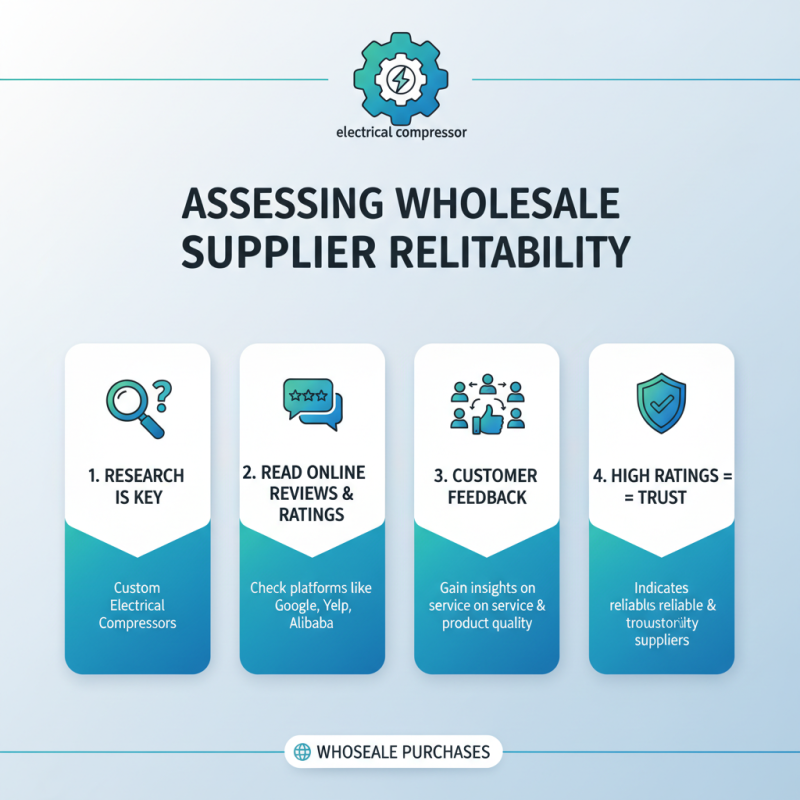
When selecting a wholesale custom electrical compressor, assessing supplier reputation is crucial. Research is key. Read online reviews and ratings. Feedback from previous customers offers insights into reliability. High ratings often indicate a trustworthy business.
Don’t overlook industry certifications. These can serve as a benchmark for quality and safety. However, understand that certifications may vary in relevance. Some suppliers might have all the right papers but fail in execution. Contact past clients for their feedback. Their experiences can be enlightening.
Reliability in a supplier goes beyond just products. It involves communication and service. Slow responses to inquiries can be a red flag. Evaluate how quickly and effectively a supplier addresses your questions. A responsive supplier shows they value your business. Be cautious, as not every flashy website reflects genuine reliability.
When selecting a wholesale custom electrical compressor, after-sales support is crucial. Reports show that 72% of businesses prioritize service quality alongside product features. A reliable after-sales service can save businesses time and money. Many wholesalers offer maintenance packages. These packages can include regular check-ups or troubleshooting assistance.
Consider the average downtime costs. According to industry studies, unplanned downtime can cost businesses $260,000 per hour. This emphasizes the need for a reliable
Home Compressor that comes with strong support. Ensure that the supplier offers a clear response timeline for service requests. Some suppliers may promise quick support but fail to deliver.
Training is another aspect to consider. A well-trained support team is invaluable. About 60% of companies say they struggled with maintenance due to lack of training. Investing in suppliers with comprehensive training resources can enhance operational efficiency. Make sure to inquire about these resources when choosing your electrical compressor.
The 2023 Global Compressor Market Report highlights the benefits of oil-lubricated two-stage screw air compressors, which are transforming industrial efficiency. With the ability to compress air in two stages, this technology significantly enhances energy efficiency, achieving energy savings of 5-8% compared to traditional single-stage compressors. The innovative design features the injection of fresh oil between the compression stages, effectively lowering the inlet temperature of the second stage. This reduction in temperature optimizes the compression ratio, making it closer to isothermal conditions and thus improving overall performance.
Moreover, the two-stage air compressors are engineered with advanced variable speed technology, allowing for better efficiency and substantial energy savings. With superior volumetric efficiency stemming from minimized leakage between rotor seals, these compressors ensure stable airflow and consistent outlet temperatures across various industrial applications. Whether in manufacturing, construction, or energy production, the benefits of reduced power consumption—up to 35% less than conventional models—make the two-stage screw air compressors an essential choice for businesses aiming to enhance their operational efficiency and achieve significant cost savings.
: Understanding requirements ensures you choose the right compressor for your industry. Each sector has unique demands.
Consider energy efficiency, expected output, pressure levels, and workspace configuration to avoid performance issues.
Common types include rotary screw, reciprocating, and scroll compressors. Each serves different applications and efficiency needs.
The layout and available space affect installation costs and performance. Compact designs may fit but need sufficient capability.
Look for reputation, customer reviews, industry certifications, and responsiveness to inquiries. Communication is critical for reliability.
Regular maintenance extends a compressor's lifespan, reduces downtime, and enhances return on investment.
Energy efficiency is a major priority. Choosing an efficient compressor helps lower operational costs significantly.
Investigate further by contacting past clients for their experiences. Personal insights can provide clarity on the supplier's reliability.
A larger horsepower compressor can suit medium to large enterprises. Small businesses should assess actual needs before purchasing.
Evolving needs may require revisiting your compressor selection. Regular assessments help ensure alignment with current operations.
When selecting a wholesale custom electrical compressor for business needs, it's essential to understand its significance in operational efficiency and productivity. Start by identifying your specific requirements, as the type of compressor must align with your business processes. Explore various available types and focus on their energy efficiency ratings, which can lead to considerable savings in operational costs.
Additionally, analyzing the cost-benefit ratios is crucial to ensure that your investment aligns with your budgetary constraints. Evaluating the reputation and reliability of suppliers can help secure quality products, while also considering after-sales support and maintenance services to ensure long-term functionality of the electrical compressor. Overall, a thoughtful approach to these factors will lead to a well-informed decision that enhances your business performance.